With a $1,000 account, the question is not "which coin will go up" but "how much do I buy so that being wrong does not hurt". Position sizing answers that question before you enter, and it is the single habit that keeps a small account alive long enough to learn.
This guide gives you the formula, three worked examples, and the specific problems a small account runs into: minimum order sizes, leverage and fees.
The one formula
Position size = (account x risk percent) / (entry - stop)
- Account x risk percent is the amount in dollars you accept to lose if the stop is hit. On $1,000 at 1 percent, that is $10.
- Entry - stop is the distance in price between where you get in and where the idea is wrong.
- The result is the number of units (coins, shares, ounces) to buy.
Notice what is missing: how confident you feel, how much you want to make, how much money is in the account in total. Size comes from the stop distance and the dollar risk only.
If you do not have a stop yet, you cannot size the trade. Start with how to set a stop loss, then come back.
How much to risk per trade on $1,000
Many educators suggest risking between 0.5 and 2 percent of the account per trade. On $1,000 that is $5 to $20.
That feels tiny, and that is the point. The arithmetic of losing streaks is unforgiving:
| Risk per trade | Account after 10 losses in a row |
|---|---|
| 1 percent | about $904 |
| 2 percent | about $817 |
| 5 percent | about $599 |
| 10 percent | about $349 |
Ten losses in a row sounds unlikely, but even a strategy that wins half the time will see long streaks over a few hundred trades. At 1 percent you are still in the game. At 10 percent you would need to almost triple the account to get back to $1,000. The free drawdown recovery calculator runs these numbers for any risk percent and streak.
A simple rule for a beginner: risk 1 percent, so $10, until you have at least 50 logged trades and know your own win rate.
Example 1: crypto
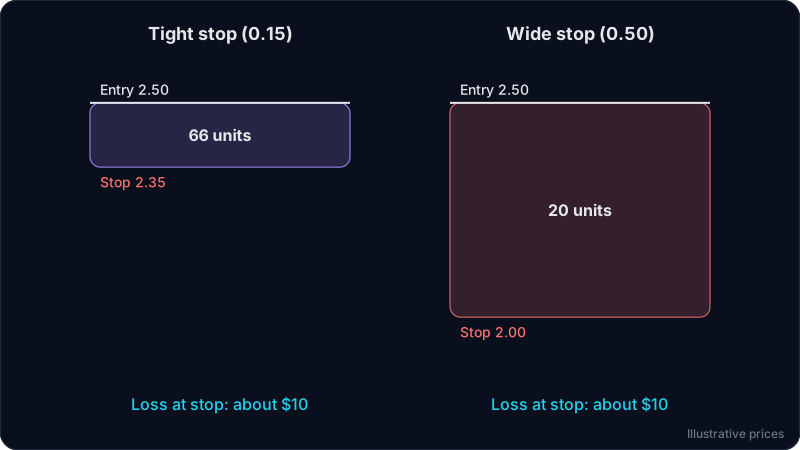
These numbers are illustrative and not tied to any live market.
- Account: $1,000. Risk: 1 percent, so $10.
- You want to buy a coin at 2.50. The stop, below the last swing low with a buffer, is at 2.35.
- Stop distance: 2.50 - 2.35 = 0.15.
- Size: $10 / 0.15 = 66.6 coins, round down to 66.
- Position value: 66 x 2.50 = $165.
You are buying $165 worth of the coin, not $1,000 worth. If the stop is hit, you lose 66 x 0.15 = $9.90, plus fees. The rest of the account is untouched.
Now imagine the stop had to be at 2.00 because the nearest real support is far away. Size: $10 / 0.50 = 20 coins, a $50 position. Wide stop, small size. The loss in dollars is the same.
Example 2: forex
Forex is sized in lots, so add one step.
- Account: $1,000. Risk: $10.
- EUR/USD long at 1.0850 with a stop at 1.0820: a stop of 30 pips.
- On EUR/USD, one micro lot (1,000 units) is worth about $0.10 per pip.
- Dollars per pip you can afford: $10 / 30 = about $0.33.
- Size: 0.33 / 0.10 = 3 micro lots (0.03 lots).
If your broker only offers mini lots (10,000 units, about $1 per pip), the smallest position would risk $30 on this trade, which is 3 percent. The honest choice is to use a broker that offers micro lots or skip the trade. The free pip value calculator does the per-pip step for other pairs.
Example 3: stocks
- Account: $1,000. Risk: $10.
- A stock at $42.00 with a stop at $40.80.
- Stop distance: $1.20.
- Size: $10 / 1.20 = 8.3 shares, round down to 8 shares, a $336 position.
If your broker does not support fractional shares, always round down. Rounding up quietly raises your risk.
The problem with minimum sizes
Small accounts hit a wall that big accounts never see: the minimum order size. Some exchanges and brokers set a minimum trade value, and a full lot of anything is far beyond a $1,000 account.
When the minimum size would make you risk more than your rule allows, you have three options:
- Find a tighter, still valid stop by waiting for a better entry closer to the level. This is the best option because it also improves your risk to reward. See risk reward ratio explained.
- Trade a market or instrument with smaller units, such as micro lots, fractional shares or a lower-priced pair.
- Skip the trade. There will be another one.
The option to avoid is accepting 4 or 5 percent risk "just this once".
Leverage does not change your risk
Leverage lets you open a position larger than your cash. It does not change the formula.
If the formula says 66 coins and you open 66 coins with 10x leverage, you put up less margin but you still lose about $10 at the stop. If you use leverage to open 660 coins instead, you now lose about $100 at the same stop: 10 percent of the account on one idea.
Leverage also brings a liquidation price. On a leveraged position, check that the liquidation price is well beyond your stop; if the exchange would close you before your stop is reached, the position is too large.
The safe way to think about it: decide size with the formula first, then use only the leverage needed to open that size.
Fees on a small account
Fees take a larger share of small trades. If a round trip costs 0.2 percent of the position value, a $165 crypto position pays about $0.33. That is 3.3 percent of the $10 at risk, and it comes off every winner and adds to every loser.
Two habits help:
- Prefer setups with a reward of at least twice the risk, so costs are a smaller share of the outcome.
- Avoid very tight stops on low timeframes, where the spread alone can be a large part of the stop distance.
A pre-trade sizing checklist
- Where is the stop, and is it at the price that invalidates the idea?
- What is 1 percent of the account today (not the starting balance)?
- Size = dollar risk / stop distance, rounded down.
- Does the position meet the minimum order size without breaking your risk rule?
- If leveraged, is the liquidation price beyond the stop?
- After fees, is the trade still worth taking?
The free position size calculator does steps 2 and 3 for you.
Common mistakes
- Sizing by feel. "This one looks strong, I will go bigger" is how one trade wipes out ten good ones.
- Using the whole account per trade. Buying $1,000 of a coin with a stop 10 percent away is a $100 risk, ten times the rule.
- Moving the stop to fit a size. The stop comes from the chart; the size adapts to it, never the other way around.
- Not updating after losses or wins. Recalculate 1 percent from the current balance.
- Adding to losing positions. Averaging down raises the risk of a trade that is already proving you wrong.
FAQ
How much should I risk per trade with $1,000?
A common range is 0.5 to 2 percent, so $5 to $20. One percent ($10) is a sensible default while you learn, because it survives long losing streaks with most of the account intact.
Can I grow a $1,000 account with 1 percent risk?
It grows slowly, and that is the trade-off for survival. A small account is best used to prove a process: a stop on every trade, consistent sizing, and a journal. Results in R tell you whether the process works, whatever the account size.
Should I use leverage on a small account?
Only to open the size the formula gives you, never to make the position bigger. Leverage does not change how much you lose at the stop if the size is right, but it makes it very easy to size too large.
What if my broker's minimum lot is too big?
Then the trade does not fit your account at that stop. Look for a tighter, valid entry, switch to an instrument with smaller units, or skip it.
Do I size the same way on every timeframe?
Yes. The formula works the same on a 5 minute chart and a daily chart. Higher timeframes usually need wider stops, which simply means smaller positions.
Try it on your own chart
ChartEdge AI reads your chart screenshot and returns an entry, a stop loss and targets, which are exactly the numbers the sizing formula needs. Upload a chart, plug the entry and stop into the position sizer, and you know your size in seconds. Try it with 3 free analyses, no card required. Educational only, not financial advice.