A liquidity sweep is a quick move just beyond an obvious high or low that reverses almost at once. Price pokes below a level where many traders keep their stops, triggers those orders, and then closes back on the other side. Many traders call it a stop hunt.
You do not need to believe that someone is hunting your stop for the idea to be useful. The mechanics are simple: obvious levels collect orders, orders are liquidity, and large moves often start right after that liquidity has been used.
This guide shows where liquidity sits on a chart, how a sweep differs from a real breakdown, and how to plan a trade around one, with a full worked example.
Where the liquidity sits
Liquidity means resting orders that can be filled. On a chart screenshot, it tends to pile up in a few places:
- Equal lows and equal highs. Two or three lows at almost the same price look like strong support to many traders, so they put their stops just below. Same idea above equal highs.
- Obvious swing highs and lows. The last clear swing low in an uptrend is where many long positions keep their stop.
- Round numbers. Prices like 100, 1.1000 or 2,000 attract stops and pending orders.
- The edges of a range. Breakout traders place buy stops above the range and sell stops below it.
Below equal lows you find sell-side liquidity: the stops of buyers are sell orders. Above equal highs you find buy-side liquidity: the stops of sellers are buy orders.
What a sweep looks like
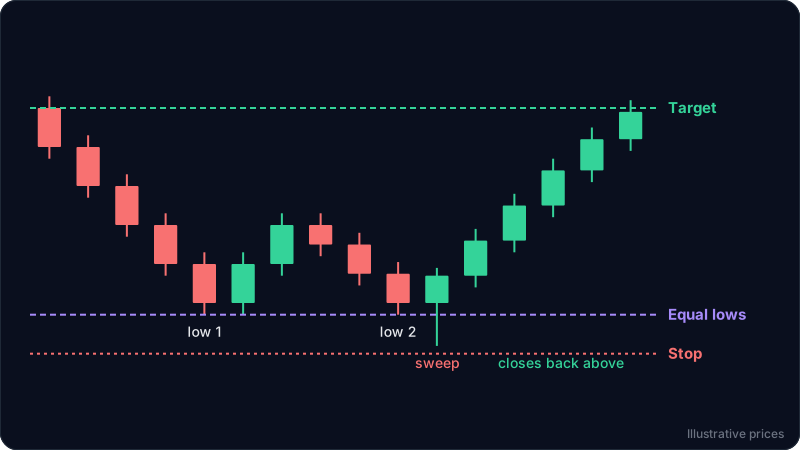
A bullish sweep of sell-side liquidity has three steps:
- The pool. Price makes two lows at about the same level. Stops build up just below.
- The sweep. One candle drops below those lows, often fast, and fills those stops.
- The rejection. The same candle, or the next one, closes back above the old lows. The move below did not hold.
A bearish sweep is the mirror: equal highs, a wick above them, and a close back below.
The key detail is the close. A long wick through the level with a close back inside is a sweep. A full candle body closing beyond the level, followed by more candles out there, is a breakdown.
Sweep or real breakdown?
This is the same question as a breakout vs a fakeout, seen from the other side. A few checks help:
- Close back inside. The sweep candle closes back above the old lows within one or two candles. If price keeps closing below, treat it as a breakdown.
- Wick size. The part below the level is mostly wick, not body.
- Higher timeframe context. A sweep of a 15 minute low that sits on top of a 4 hour demand zone has a reason to reverse. A sweep in the middle of a strong 4 hour downtrend often just continues lower. See how to use multiple timeframes.
- Where it happened. Sweeps into an area that already held before, like a demand zone or an old support, are more reliable than sweeps in open space.
- Follow-through. The next candle or two should move away from the level. If price hovers right at the old lows, the reversal is not confirmed yet.
Entry, stop and target
There are two common ways to enter after a bullish sweep:
- On the close of the rejection candle. You enter as soon as the candle closes back above the equal lows. You get a better price but less confirmation.
- On a retest. You wait for price to dip back toward the old lows and hold above them, then enter. You may miss fast moves, but the stop can be tighter.
The stop goes below the low of the sweep wick, with a small buffer. If price trades below the sweep low, the reversal idea is wrong. See how to set a stop loss.
The target is often the opposite pool of liquidity: the last clear high, or equal highs above. A first partial target can be the high between the two lows.
Worked example
These numbers match the diagram above. Prices are illustrative.
- Pool: two lows at 103.4 after a drop from 114.
- Sweep: a candle opens at 104, drops to 101.8 (below the equal lows) and closes at 105.4, back above them.
- Entry: 105.4, on that close.
- Stop: 101.4, just below the sweep wick. Risk is 4 per unit.
- First target: 108.8, the high between the two lows. Reward 3.4.
- Main target: 114, the start of the drop. Reward 8.6 per unit.
- Ratio to the main target: 8.6 / 4, about 1 to 2.15.
Check the ratio with the risk reward calculator and turn the 4 point stop into a size with the position size calculator. Wide sweep wicks mean wide stops, so the size has to come down.
Common mistakes
- Calling every break a sweep. Without a close back inside, it is a breakdown, and buying it means buying into sellers.
- Entering during the wick. Catching the low feels good when it works, but you only know it was a sweep after the close.
- Stops just below the equal lows. That is exactly where the sweep goes. Put the stop below the sweep low instead, and size down.
- Ignoring the trend. Sweeps against a strong higher timeframe trend fail more often.
- Forgetting news. Big news can push price through every level at once, and sweeps on those candles are much less reliable.
FAQ
Is a liquidity sweep the same as a stop hunt?
They describe the same move. "Stop hunt" suggests someone is aiming at your stops. "Liquidity sweep" just describes what happens: price runs through an area full of resting orders and then reverses.
What timeframe works best for sweeps?
They appear on every timeframe. Lower timeframes show more sweeps and more failures. Many traders mark the pool on a higher timeframe (1 hour or 4 hour) and look for the sweep and the rejection on a lower one.
How do I avoid getting my stop swept?
Avoid placing it exactly under obvious equal lows or round numbers. Put it below a level that would really prove your idea wrong, and size the position to that distance.
How often do sweeps lead to a reversal?
We do not quote a success rate. It depends on the market, the timeframe and how each trader defines a sweep. Treat it as a setup to plan with a stop, not as a guarantee.
Try it on your own chart
ChartEdge AI reads a chart screenshot and gives you the trend, the key support and resistance zones, and a plan with entry, stop and targets. Use it to check whether the lows you think were swept line up with real levels before you act. Try it with 3 free analyses, no card required. Educational only, not financial advice.